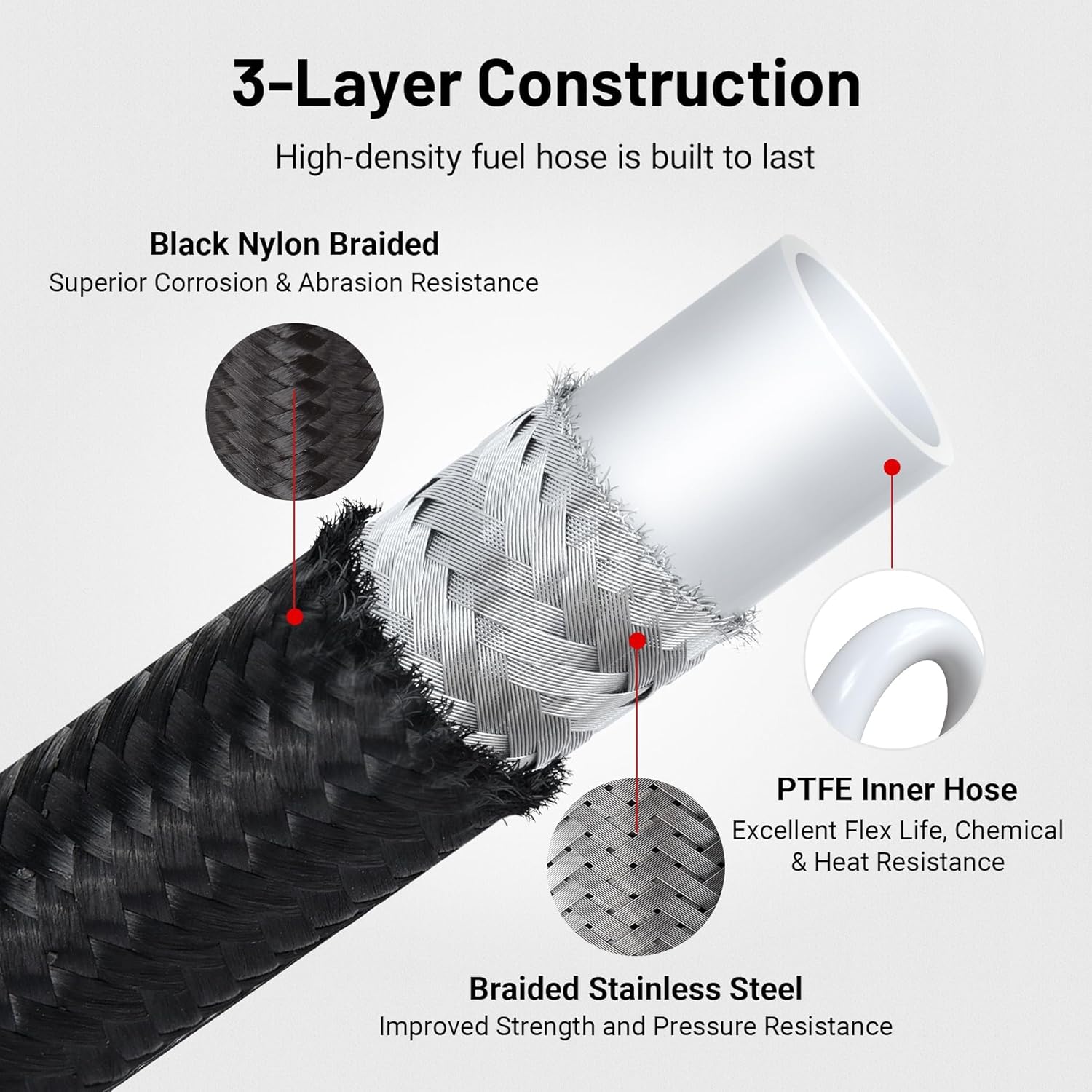
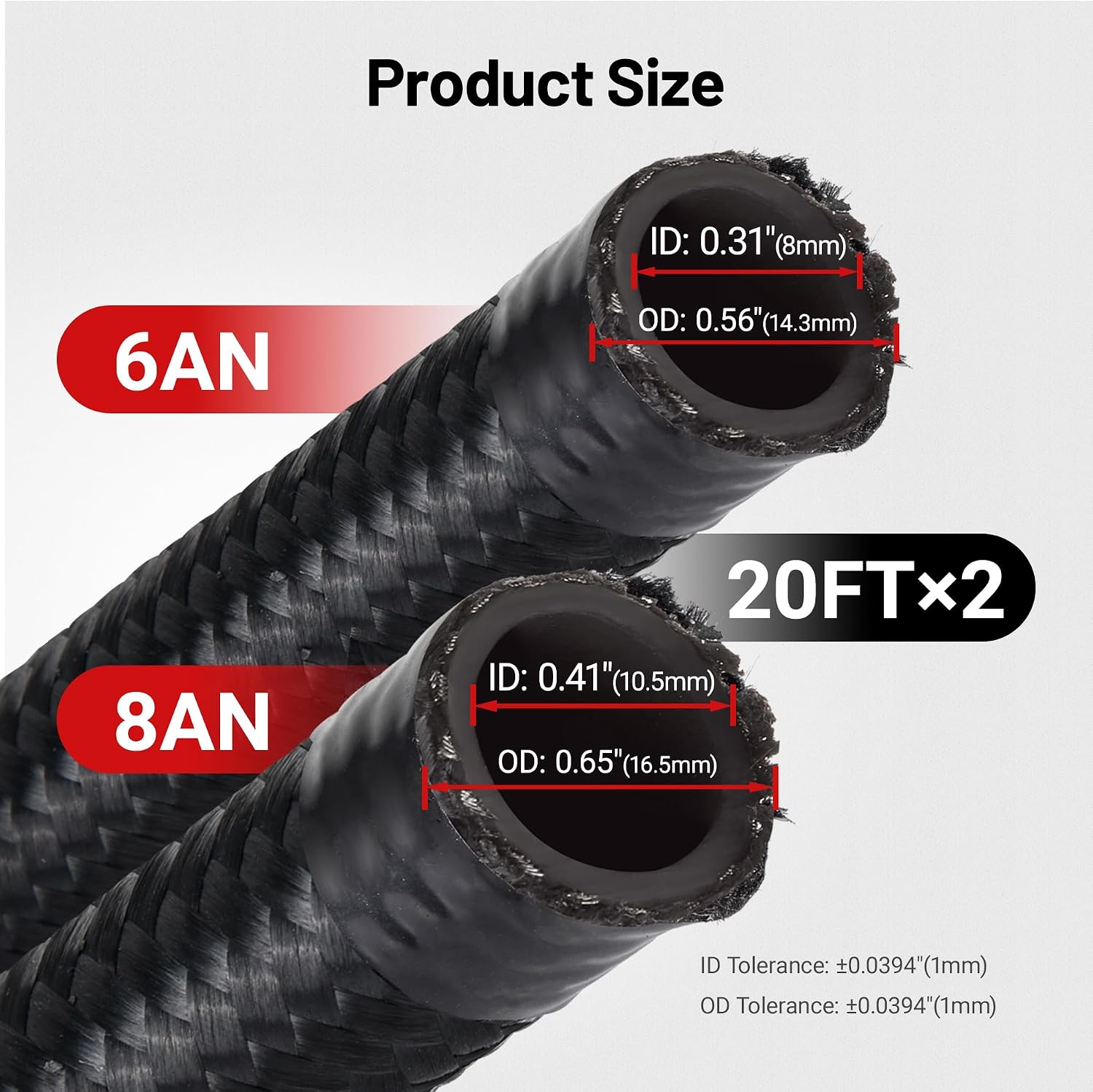
If you’ve been shopping fuel line for an LS swap, you’ve probably already run into two acronyms that look interchangeable until the price difference slaps you in the face: PTFE and CPE. PTFE (polytetrafluoroethylene — the same slippery fluoropolymer used in non-stick cookware) is a smooth-bore inner liner that’s chemically inert to nearly every fuel on the market, including E85. CPE (chlorinated polyethylene) is a more traditional rubber-type liner that has been the standard in automotive fuel hose for decades and handles pump gas just fine. Both get wrapped in a stainless steel braid — that’s the shiny exterior you see on AN-style hose — and both come in the same 6AN diameter (roughly 3/8-inch inside). The braid isn’t decorative. It’s load-bearing. Understanding what it actually does — and what the liner underneath it does — is the difference between a fuel system that’s bulletproof on E85 and one that quietly degrades and drops fuel pressure eighteen months from now.
This article is a direct comparison: PTFE versus CPE for 6AN fuel line on E85 LS swaps. We’ll cover the material science in plain language, walk through the cost math, and give you a clear decision rule at the end organized by build tier.
| EDITOR'S PICK[EVIL ENERGY 2 Kit 6AN 8AN Fuel…](https://www.amazon.com/dp/B0D83H6SFF?tag=greenflower20-20) | Mid-tier[EVIL ENERGY 8AN PTFE Fuel Line…](https://www.amazon.com/dp/B0922KVTWC?tag=greenflower20-20) | Budget pick[EVIL ENERGY 6AN Fuel Line Kit](https://www.amazon.com/dp/B0D83RLSWB?tag=greenflower20-20) | |
|---|---|---|---|
| Hose Type | CPE | PTFE | CPE |
| AN Size Hose | 6AN+8AN | 8AN | 6AN |
| Length | 40FT | 20FT | 20FT |
| Fittings | 24PCS | — | — |
| E85 Compatible | — | ✓ | — |
| Color | — | Black | Black |
| Price | $128.79 | $104.99 | $69.99 |
| See on Amazon → | See on Amazon → | See on Amazon → |
Why the Liner Material Is the Only Spec That Matters for E85
When you’re running E85 — a blend of 85% ethanol and 15% gasoline — the ethanol fraction is the aggressor. Ethanol is a polar solvent. It attacks the plasticizers in conventional rubber hoses over time, causing the inner liner to swell, crack, or shed particulates that end up in your injectors. SAE International’s SAE J30 Fuel and Oil Hose Standard categorizes hose by fuel-compatibility ratings, and the key distinction is resistance to oxygenated fuels. CPE hose typically meets SAE J30 R9 or R12 ratings, which are designed for conventional gasoline and some ethanol blends — but “some blends” in that standard’s language often addresses concentrations well below straight E85.
PTFE, by contrast, is chemically non-reactive to ethanol, methanol, and virtually every hydrocarbon fuel. The Earls Performance Plumbing PTFE Hose Technical Reference Guide documents a chemical resistance range that spans gasoline, diesel, E85, methanol, and nitromethane — all without liner degradation. That’s not marketing copy; it’s a function of fluoropolymer chemistry. There are no plasticizers in PTFE to leach out. The molecule simply does not bond with ethanol.
The practical implication: On an E85 build making serious power through a Holley Sniper 2 or Holley HP EFI system, running CPE hose is a deferred maintenance decision. The hose won’t fail on day one. It may not fail in year one. But Engine Labs, in their editorial coverage of E85 fuel system requirements (“E85 Fuel System Upgrades: What You Actually Need,” enginelabs.com), has noted that shops building serious ethanol-fueled street/strip cars have documented injector contamination traced to degraded CPE liner particulates after regular E85 use. On a $2,200-plus Holley HP EFI setup with $400 injectors, that’s an expensive gamble for the sake of saving $100 on hose.
What the Braiding Spec Actually Does — and What It Doesn’t
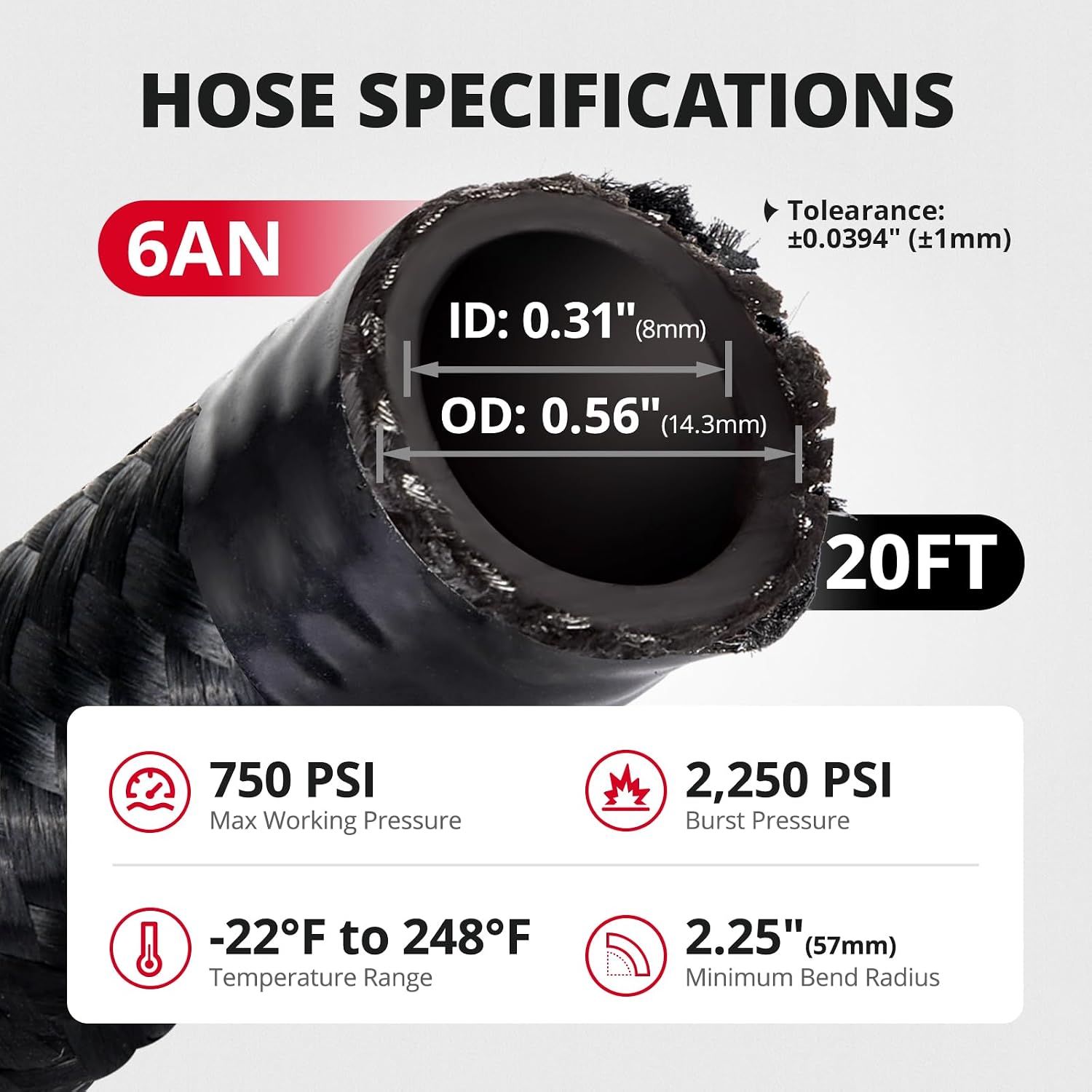
Here’s where a lot of builders get confused: they see “stainless steel braid” on both PTFE and CPE hose and assume the braid makes them equivalent. It doesn’t. The braid has one job — pressure containment. It holds the inner liner from ballooning under fuel system pressure. On a returnless EFI system like those driven by a Walbro 450 or Aeromotive Phantom pump, operating pressure typically runs 43–65 PSI for a port-injected LS application. Both 6AN PTFE and CPE braid-covered hose are rated well above that — most manufacturers spec their braided 6AN hose at 350–500 PSI burst pressure.
So the braid is not your differentiator. The braiding spec — the number of carriers, the angle of weave — affects burst pressure and kink resistance, but neither liner type is going to burst at normal LS fuel system pressures. Where PTFE pulls ahead has nothing to do with burst pressure and everything to do with what’s happening at the molecular level in the liner over time.
One secondary advantage PTFE offers is lower fuel vapor permeation. SAE International’s J30 standard and the Earls Performance Plumbing PTFE Hose Technical Reference Guide both recognize that fuel vapor permeates through hose walls at different rates depending on liner material. PTFE’s permeation rate is dramatically lower than CPE, which matters for CARB compliance in California. PTFE hose is generally accepted under California emissions testing; CPE hose on an EFI-converted vehicle is frequently a smog-check vulnerability. If your build needs to pass a visual or functional inspection, this is not a small footnote.
OnAllCylinders, in their overview “Understanding AN Fittings and Hose Types” (onallcylinders.com), also points out that PTFE’s smooth inner bore produces less turbulent flow and marginally lower pressure drop over long runs compared to the slightly rougher inner surface of CPE — a small but real advantage on high-flow applications above 600 RWHP where every PSI of feed pressure matters.
PTFE vs. CPE by Build Tier: How to Choose for Your Application
This is where the decision lives. Rather than a blanket recommendation, the right answer depends on what fuel you’re running, what power level you’re targeting, and what your long-term ownership plan looks like. The three tiers below map to the three most common LS swap scenarios.
Budget Tier: Pump Gas, Street Driver, Self-Learning TBI System
If you’re running a pump-gas LS swap — E10 or lower — with a self-learning throttle-body EFI system like the Holley Sniper 1 or FiTech Go Street, CPE braided 6AN hose is a defensible choice. Hot Rod Magazine’s LS swap fuel system coverage (“LS Swap Fuel System Guide,” hotrod.com) frames this well: the components most likely to be overlooked on a budget build are the ones you can’t see once the car is assembled, but on a pump-gas build with no E85 ambitions, quality CPE from a name-brand manufacturer — Gates, Aeroquip, or equivalent — will perform reliably if you inspect it at every service interval.
Buy rule: Choose CPE only if you are certain your fuel strategy will not change. If there is any chance you’ll run flex fuel later, PTFE now costs less than a second installation later.
EVIL
$69.99
In stock on Amazon
Check price on AmazonMid-Tier: E85 or Flex Fuel, Port Injection, Moderate Power
This is the most common LS swap profile on enthusiast builds: a port-injected Gen III or Gen IV LS (LS1, LS3, LS6, L99) with a Holley Sniper 2, Holley HP EFI, or MSD Atomic AirForce system, running a flex-fuel tune or dedicated E85 map in the 400–600 RWHP range. This is where PTFE earns its premium.
The Holley Performance LS Swap EFI Fuel System Installation Manual, Rev. 4 specifically calls out PTFE-rated hose ends as required for E85 applications when using Holley’s recommended inline filter assemblies. That’s not a suggestion — it’s a callout in the installation documentation. Running CPE in this application puts injector longevity and fuel delivery consistency at risk over an 18–36 month horizon.
Use 6AN PTFE braided hose with PTFE-rated AN fittings — not standard push-lock CPE fittings, which will not seal correctly on the harder PTFE liner. The Earls Performance Plumbing PTFE Hose Technical Reference Guide and the OnAllCylinders AN fittings overview both confirm that PTFE hose requires either a PTFE-specific reusable AN end (collar-and-ferrule geometry, available from Earls, Russell, and Fragola) or a factory-swaged (crimped) assembly. Pre-swaged kits are the easiest route for builders who don’t own a hose-end swager: the fitting is mechanically crimped at the factory, leak-proof, and ready to install — you just need to order the correct length.
EVIL
$104.99
In stock on Amazon
Check price on AmazonPremium Tier: Dedicated E85 or Methanol, High-Power Sequential Injection, California Emissions
For builds above 600 RWHP on E85 or methanol — dedicated street/strip, endurance, or boosted applications running sequential port injection with a Holley Dominator or comparable system — PTFE with swaged ends and verified 304 stainless braid is the minimum spec, and you should strongly consider stepping up to -8AN on the feed side. The 6AN feed restriction becomes the next limiting factor at high fuel demand, and addressing it at build time is far cheaper than chasing a fuel starvation issue on a dyno.
For California residents, PTFE is essentially non-negotiable. The lower permeation rate is the decisive factor for emissions compliance on EFI-converted vehicles, independent of power level or fuel type.
At this tier, pre-assembled PTFE hose kits from manufacturers like Aeromotive or Earls — with swaged stainless ends and documented pressure ratings — are the correct purchase. Custom-length cuts with reusable PTFE fittings are appropriate if you have the tooling and want precise routing; otherwise, a pre-assembled kit eliminates installation error.
EVIL
$128.79
In stock on Amazon
Check price on AmazonThe Cost Math: PTFE Premium vs. CPE Savings
Let’s put numbers on the table for a typical LS swap fuel line kit — approximately 10 feet of feed line and 6 feet of return line, 6AN, with end fittings.
| Configuration | CPE Braided | PTFE Braided |
|---|---|---|
| Hose only (16 ft.) | ~$45–$65 | ~$110–$160 |
| Kit with fittings included | ~$90–$130 | ~$180–$260 |
| Premium pre-assembled (Earls, Aeromotive) | ~$120–$160 | ~$220–$320 |
Prices reflect mid-2026 market conditions. Verify current pricing with your retailer before purchasing.
The PTFE premium runs roughly $90–$150 over CPE for a complete swap kit. On a build where you’re already writing checks for an LS crate engine, an EFI system, and fabrication time, that delta is real but not prohibitive. As Hot Rod Magazine’s LS swap fuel system editorial notes, fuel line is among the components least likely to be inspected once the car is assembled — which means it needs to be right the first time.
For a pump-gas build with no E85 plans, CPE is a serviceable choice if you’re using quality hose and planning periodic inspection. For anything running E85 at any meaningful duty cycle, the cost-of-ownership math favors PTFE before the end of year two.
The Bottom Line
The braiding spec on AN fuel hose is the least important thing on the label. What matters is what’s inside the braid — and on an E85 LS build, that answer is PTFE, without much debate. The fitting compatibility issue is real and worth knowing before you order, not after: PTFE hose requires PTFE-specific AN ends or factory-swaged assemblies, and standard CPE push-lock fittings will not seal correctly on the harder fluoropolymer liner.
Spec the liner for the fuel you’re going to run, not the fuel you’re running today. LS swaps have a way of gaining power, and E85 has a way of following that power.
Pricing data reflects mid-2026 market conditions. Always verify current pricing with your retailer before purchasing.