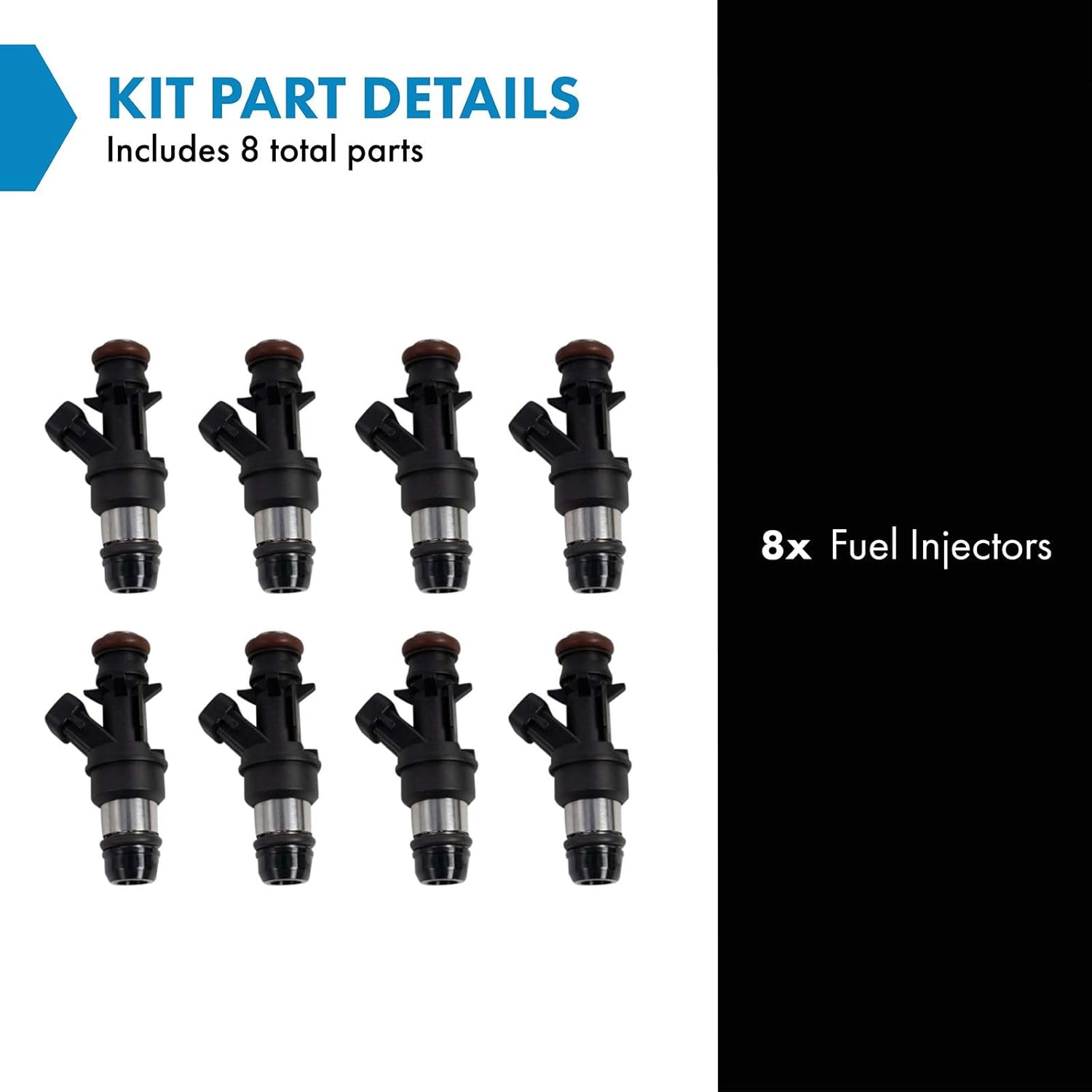
If you’ve ever watched an EFI-swapped V8 idle rough, surge at cruise, or go lean at the top of the rev range, there’s a decent chance the injectors were part of the story. Fuel injectors — the small solenoid-operated valves that spray atomized fuel directly into each intake port or throttle body passage — are the link between your ECU’s fuel command and what actually reaches the combustion chamber. When they’re mismatched in flow rate, worn unevenly, or simply undersized for a power upgrade, the ECU has to compensate harder and harder until it simply can’t. This guide is for builders who already have a basic EFI system running and are either troubleshooting a set of suspect injectors, speccing a replacement set for a rebuild, or trying to figure out whether a power upgrade means the current injectors have to go. By the end, you’ll have a clear sizing method, a handle on connector compatibility (it matters more than most people expect), and a working decision rule for when to swap.
Why Flow Matching Is the First Number That Matters
Injectors are rated in pounds per hour (lb/hr) or cubic centimeters per minute (cc/min) — both measure how much fuel the injector can deliver at a given fuel pressure, typically 43.5 psi (3 bar) for most returnless EFI systems and 58 psi for GDI-adjacent port systems. The rating you see on a spec sheet is the static flow at that reference pressure. What the ECU actually controls is duty cycle — the percentage of time the injector is held open during each firing event. A healthy operating range is 75–80% duty cycle at wide-open throttle. Go much higher and you’re crowding the injector’s ability to close and reopen cleanly; owners running sustained duty cycles above 85% consistently report lean conditions at peak power that no tune can fully cure.
The sizing math is straightforward:
By the numbers:
- Target injector size (lb/hr) = (Engine HP × BSFC) ÷ (Number of injectors × Max duty cycle)
- Typical BSFC for a naturally aspirated V8 on pump gas: 0.45–0.50
- Target duty cycle ceiling: 0.80 (80%)
- Example: 500 hp NA V8, 8 injectors → (500 × 0.50) ÷ (8 × 0.80) = 39 lb/hr minimum
That result is your floor, not your ceiling. Most builders land on the next standard size up — in this case, 42 lb/hr injectors — to preserve headroom without jumping so far that low-speed fuel resolution suffers. Engine Labs’ injector sizing overview makes the point clearly: oversized injectors on a mild street engine force the ECU to command very short pulse widths at idle, which degrades atomization and makes idle quality worse, not better. There’s no performance win in going dramatically oversized unless boost or nitrous is in the picture.
For boosted and nitrous applications, the BSFC number climbs — turbocharged engines running E85 can push BSFC to 0.65 or higher, and the Hot Rod Network’s fuel injector selection guide recommends adding a 20% safety margin on top of the calculated size for any forced-induction build. Do that math before you commit to a set.
Connector Types: The Compatibility Problem Nobody Warns You About
Here’s where a lot of otherwise solid builds hit an unnecessary wall. There are three connector families you’re likely to encounter on a V8 EFI swap, and they are not interchangeable without adapters or re-pinning:
EV1 (USCAR / Jetronic / Multec): The classic bowtie-shaped two-pin connector, dominant on GM TBI and early Gen I/II small-block applications through the mid-1990s. If you’re building around a square-port 5.7L TBI truck intake or an early LT1, this is your baseline. EV1 injectors are widely available and inexpensive, and the connector is still used on many aftermarket crate injector sets because of parts-supply depth.
EV6 (USCAR-2 / Multec 2): The rectangular two-pin connector that became standard with Gen III LS architecture (LS1 onward) and most modern OEM multi-port systems. If you’re doing an LS swap with a stock or factory-style harness, you’re in EV6 territory. This is also the connector used on most mid-range aftermarket injectors from Delphi, Bosch, and Siemens Deka in the 42–60 lb/hr range. EV6 injectors are generally the easiest to source in matched sets.
EV14 (Bosch / “short” body): Shorter body length with the same EV6 electrical connector. Popular in high-flow applications (80 lb/hr+) because the shorter body fits more easily in tight port configurations. The Siemens Deka 80 lb/hr injectors — a longtime reference set in the LS forced-induction community — use this format.
The practical issue: if you’re sourcing a replacement set for a Holley HP EFI or MSD Atomic build using a custom harness, most integrators wire to EV6. Buying an EV1 set because it was cheaper without checking harness pinout is a common mistake. Adapters exist and work fine, but they add a potential failure point inside a hot engine bay. The Holley Sniper EFI installation manual explicitly calls out connector compatibility as a pre-purchase confirmation step, and it’s worth taking seriously.
When speccing a matched set, ask the supplier for a flow-match report — this is a document showing each injector’s measured flow at reference pressure and the spread across the set. SAE technical paper 2019-01-0275 on injector flow matching effects in multi-cylinder engines found that a ±2% spread across a set produced measurably more consistent cylinder-to-cylinder fueling than sets with ±4–5% spread, particularly at part-throttle. OEM replacement sets from major suppliers like Delphi and Bosch are typically matched to ±1–2%. If a supplier can’t provide a flow-match cert on a high-performance set, that’s worth factoring into the decision.
When to Upgrade vs. When to Replace In-Kind
This is the real decision most builders sit in front of, and it breaks down into two clean scenarios:
Scenario 1: Same engine, same power level, something’s wrong. If the build hasn’t changed but you’re seeing rough idle, lean codes at cruise, or inconsistent fuel trims across banks, the problem is almost certainly injector degradation rather than sizing. Injectors wear — the needle and seat erode, internal filters clog with varnish deposits, and the solenoid response time drifts. OnAllCylinders’ injector basics guide notes that an injector with a dead or sticky solenoid can look fine on a resistance check and still deliver 15–20% less fuel than its rated flow under dynamic conditions. In this scenario, you’re replacing in-kind: same lb/hr, same connector, matched set. A professional ultrasonic cleaning and flow-testing service (offered by dedicated injector rebuild shops) can sometimes restore a set to spec, but for most V8 builds, the cost delta between cleaning and buying a quality matched replacement set is narrow enough that replacement usually wins.
Scenario 2: Power level is changing. Cam upgrade, head swap, boost addition, nitrous — any of these changes the fuel demand equation. Run the sizing formula again with the new HP target. If the result pushes you more than about 10% above your current injectors’ rated flow at 80% duty cycle, it’s time to size up. The upgrade threshold isn’t always a dramatic jump: going from a stock 350 small-block at 300 hp to a cam-and-heads combination targeting 430 hp might move you from stock 28 lb/hr injectors to 36 lb/hr — a reasonable step-up that keeps the system in its efficient range without creating idle quality issues.
For LS builders in particular, the 42 lb/hr EV6 set is often described by the LS community as a natural upgrade plateau for naturally aspirated builds making 450–500 hp on 93-octane fuel. Above that, the 60 lb/hr and 80 lb/hr Siemens Deka sets are frequently cited reference points for boosted applications.
Sourcing a Matched Set: What to Look For
A few practical filters before you buy:
Matched flow certification. Any purpose-built performance injector set should include a flow-match sheet. If it’s sold as “OEM replacement” grade without one, verify the supplier has a reputation for consistent tolerances.
Fuel compatibility. E85 and ethanol blends are harder on injector internals than gasoline. Injectors marketed as “flex-fuel compatible” use alcohol-resistant internal materials and seals. Running E85 through a non-compatible set shortens injector life significantly — this is documented in multiple ethanol conversion tech guides from Holley and noted in Hot Rod Network’s E85 swap coverage.
O-ring sizing. Injectors mount via top and bottom O-rings that have to match the fuel rail and intake port dimensions. Most 14mm top/9mm bottom O-ring sizes are interchangeable across common applications, but confirm before ordering — a mismatch means a leak.
Retailer pricing context (as of mid-2026): OEM-spec matched replacement sets for common LS applications (42 lb/hr, EV6, set of 8) typically run $180–$260 depending on brand and sourcing. Purpose-matched high-performance sets in the 60 lb/hr range from established suppliers land at $350–$500 for a full V8 set. The Siemens Deka 80 lb/hr sets — a common reference for boosted LS builds — are widely available in the $450–$600 range for eight-injector sets. Always check current retailer pricing before committing; prices on performance injector sets have tracked fuel system component demand closely in 2025–2026.
The Decision Rule
If your power level is staying the same and you’re seeing fueling symptoms: replace in-kind with a flow-matched set, confirm connector type before ordering, and rule out the fuel pump and pressure regulator first so you’re not chasing symptoms with parts.
If your power level is increasing: run the sizing formula, find the next standard size that puts you at 75–80% duty cycle at peak HP, confirm E85 compatibility if applicable, and verify your ECU’s injector scaling parameters before the first startup — a correctly sized injector on a misconfigured ECU is still a problem.
The injectors are one of the cheaper leverage points in a V8 EFI build relative to what they control. Getting them right — sized correctly, flow-matched, connector-compatible — means the ECU isn’t constantly compensating, the tune holds, and the system delivers what it promises. Get them wrong and no amount of tuning time fully makes up the difference.