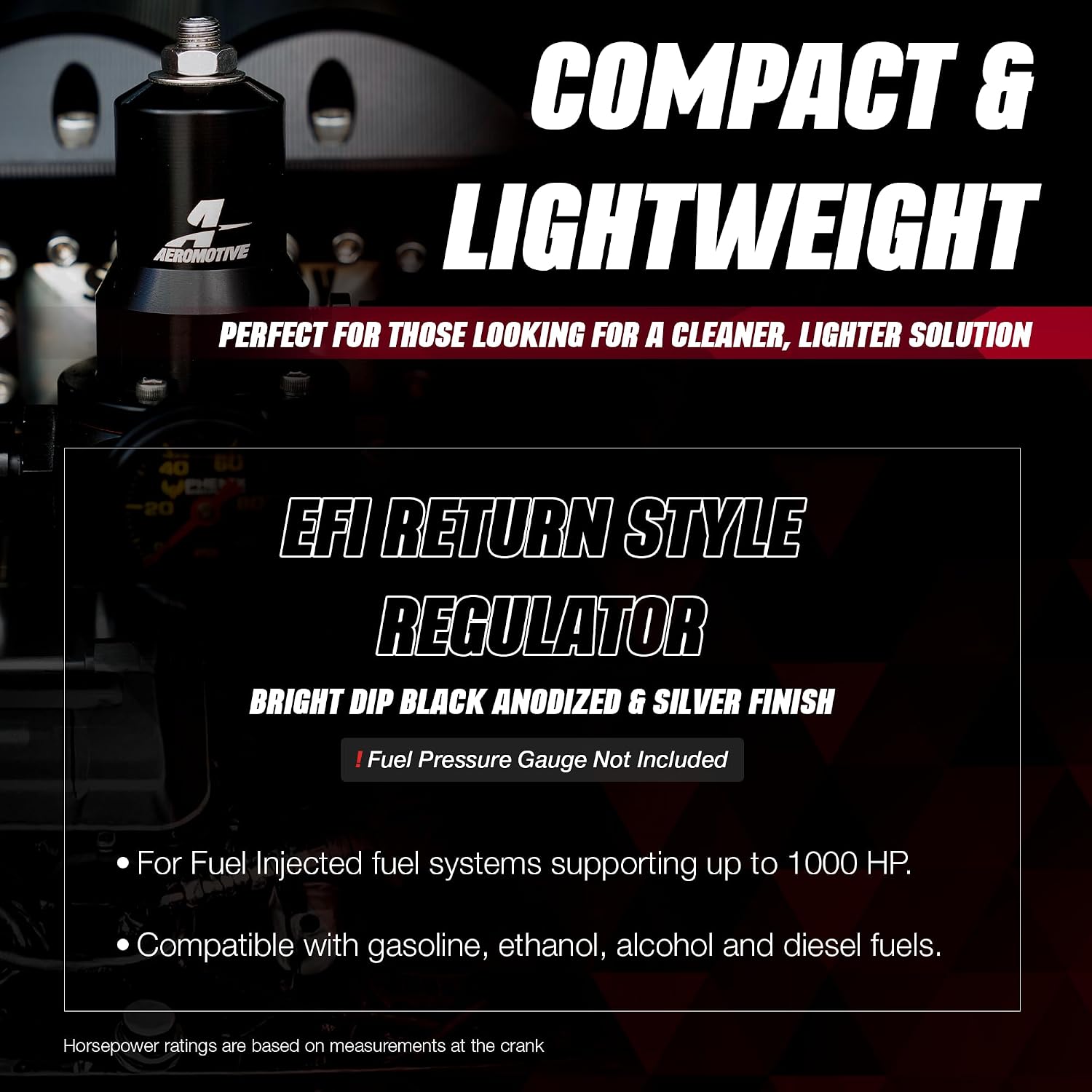
If you’ve been researching an EFI swap for any length of time, you’ve probably seen “fuel pressure regulator” on every parts list without anyone clearly explaining what it does or why it matters. Here’s the short version: your fuel injectors are precision devices that open and close in milliseconds, and they need fuel delivered at a consistent, controlled pressure to work correctly. A fuel pressure regulator (FPR) is the component that maintains that pressure — think of it as a pressure relief valve that bleeds off excess fuel and sends it back to the tank when it’s not needed. Get the regulator wrong and your ECU is fighting the fuel system instead of tuning it. Get it right and everything else — idle quality, wide-open-throttle fueling, self-learning accuracy — falls into place. This guide covers how to choose the right regulator for your application, how the bypass-return system works, what PSI range you actually need, and why some regulators cost $40 while others cost $400.
| EDITOR'S PICK[Aeromotive Extreme Flow EFI Fue…](https://www.amazon.com/dp/B00YJEUI8M?tag=greenflower20-20) | Mid-tier[Aeromotive EFI Fuel Pressure Re…](https://www.amazon.com/dp/B000CFQNZO?tag=greenflower20-20) | Budget pick[EVIL ENERGY Fuel Pressure Regul…](https://www.amazon.com/dp/B0FBR8CHM1?tag=greenflower20-20) | |
|---|---|---|---|
| PSI Range | 30-120 | 40-75 | 30-70 |
| Ports | Dual ORB-10 | ORB-06 | 6AN |
| Boost Ref | ✓ | ✓ | — |
| Return Style | 2-Port | Bypass | Bypass |
| Gauge Port | — | 1/8" NPT | — |
| Color | Black | — | Red |
| Price | $279.93 | $175.13 | $75.99 |
| See on Amazon → | See on Amazon → | See on Amazon → |
How a Bypass-Return Fuel System Works (and Why EFI Needs It)
A carbureted fuel system is relatively forgiving — your mechanical fuel pump delivers what the carb bowl float needle lets in, and excess pressure just backs up. EFI doesn’t work that way. Fuel-injected engines use a high-pressure in-tank or inline electric pump that runs at full output constantly, often delivering far more fuel volume than the engine needs at cruise. The bypass-return style regulator handles the overflow: it sits downstream of the fuel rail, holds pressure at a fixed set point (say, 58 psi for a typical GM LS application), and routes everything the engine didn’t consume back to the tank through a return line.
This loop matters for three reasons that Engine Labs’ EFI fuel system overview articulates clearly:
- Pressure stability. The regulator acts as a buffer between pump output and injector inlet. Without it, pressure spikes at low demand (idle) and sags under high demand (full throttle). Either condition causes fueling errors the ECU has to constantly chase.
- Fuel temperature management. Returned fuel carries heat out of the engine bay. Dead-head systems (no return) let fuel sit and heat-soak in the line, which can cause vapor lock and inconsistent injector pulses.
- Injector compatibility. Injectors are rated at a specific pressure drop across them — usually stated as a differential pressure (fuel rail PSI minus intake manifold vacuum/boost). The regulator maintains that differential so injector flow-rate tables stay valid.
A dead-head or returnless system — common on late-model OEM applications — manages pressure electronically at the pump module and doesn’t use a bypass regulator in the traditional sense. For a retrofit EFI build, especially on a muscle car with an upgraded pump, bypass-return is almost always the right architecture. Per the Holley Sniper EFI installation manual, their throttle-body systems are specifically designed around a regulated bypass-return fuel system, and they explicitly warn against dead-head setups with high-flow pumps because residual line pressure between injector pulses becomes unpredictable.
PSI Ranges: Matching Pressure to Your System
The target fuel pressure in your system depends on the injectors and the intake manifold environment they live in. Here’s how it breaks down by application type:
By the Numbers
| Application | Typical Base Fuel Pressure | Notes |
|---|---|---|
| TBI (throttle-body injection, e.g., Sniper 1, FiTech) | 9–13 psi | Lower pressure, larger injector orifice |
| Port injection, naturally aspirated (LS, SBF, BBC) | 43–58 psi | 58 psi is standard GM LS spec |
| Port injection, forced induction | 43–65 psi + boost reference | 1:1 boost-referenced rise required |
| High-horsepower race port injection (>800 whp) | 60–80 psi | Requires pump capable of 80+ psi at flow |
The single most common mistake OnAllCylinders’ fuel pressure regulator explainer flags is mismatching regulator pressure to injector design — specifically, running port injectors on a regulator calibrated for TBI pressures. The result is severe under-fueling that no tune can fully correct.
Vacuum/Boost Reference. A quality regulator for port injection will have a vacuum reference port that connects to intake manifold vacuum. This allows the regulator to rise with boost on forced-induction builds, maintaining a constant differential pressure across the injectors regardless of what’s happening inside the intake. A non-referenced regulator holds a fixed absolute pressure — which means on a 10 psi boost application, your injector pressure differential drops by 10 psi at full boost, leaning the engine out exactly when it can least afford it. Aeromotive’s Fuel System Design Guide notes this failure mode specifically and considers a vacuum/boost-referenced regulator non-negotiable for any boosted application.
Why Aeromotive Costs More — and When It’s Worth It
You can buy a billet-aluminum EFI fuel pressure regulator on the internet for $35–$50. You can also buy an Aeromotive A1000 regulator for $175–$220 (per current published retail). Both will hold pressure. Here’s where they diverge.
Bypass valve quality. The bypass valve inside a regulator is a spring-loaded poppet or diaphragm that bleeds fuel back to the return line when pressure exceeds the set point. Budget units use stamped seats and moderate-durometer diaphragms that work fine at room temperature with pump gasoline. Aeromotive’s published engineering documentation describes their units as using stainless poppet seats and a dual-layer diaphragm rated for alcohol, E85, and nitromethane fuel blends. If you’re running E85 or a methanol/water injection combination, a regulator that’s not rated for oxygenated fuels will degrade the diaphragm within a season. Hot Rod’s EFI fuel system feature series from their long-form build content has illustrated this with photos of failed budget regulators from ethanol-blend applications.
Adjustment range and stability. Entry-level regulators are often factory-set and non-adjustable, or adjustable through a narrow range with poor hysteresis (the pressure wanders as flow demand changes). Aeromotive regulators are adjustable from roughly 30–70 psi depending on model, and independent long-run reviews consistently describe stable pressure throughout the adjustment range — no pressure creep at idle, no sag at high flow.
Return port sizing. A regulator with undersized return ports creates backpressure in the return line. That backpressure raises effective fuel pressure above the set point — sometimes by 5–10 psi at high pump output. On a 600 lb/hr pump pushing hard at full throttle, this matters. Aeromotive publishes flow data through their bypass port so you can verify the regulator won’t become a restriction in your return circuit. Most budget units publish nothing.
The honest tradeoff. If you’re building a naturally aspirated small-block running a Holley Sniper 1 on 87-octane pump gas with a modest 255 lph pump, a $50 regulator will probably serve you without drama for years. The Aeromotive premium is easier to justify when: (a) you’re on E85, (b) you’re boosted, (c) you’re feeding a high-horsepower port injection system with a 450+ lph pump, or (d) you’re competing where fuel system reliability is a DNF risk. The math on a $175 regulator versus a $50 one is easy to justify if it prevents one track-day fuel gremlins session that costs you a tuning appointment.
Regulator Placement and Plumbing: The Details That Matter
Getting the regulator in the right place in the fuel circuit is as important as spec’ing the right unit.
Where it goes. The regulator belongs at the outlet end of the fuel rail — downstream of the injectors, not upstream. Placing it upstream (between pump and rail) means the injectors see unregulated pump pressure on the inlet side, which defeats the purpose entirely. Every OEM EFI system and every reputable aftermarket fuel system diagram places the regulator at the rail exit.
Return line sizing. The return line needs to be sized to carry peak bypass flow without restriction. Aeromotive’s design guide recommends a minimum 3/8-inch return line for street applications and 1/2-inch for high-flow racing systems. Undersizing the return line creates the backpressure problem described above. Many muscle-car frames have factory return line bungs or provisions; if yours doesn’t, this is the fabrication point to plan ahead.
Mounting orientation. Most diaphragm regulators are designed to mount with the adjustment screw pointing up or to the side — not inverted. Inverted mounting puts the diaphragm in an incorrect mechanical attitude relative to the spring, which can cause pressure variation. Check the manufacturer’s orientation spec; it’s usually in the first paragraph of the installation sheet and frequently ignored.
Vacuum reference routing. The manifold vacuum line on the regulator should tee into a full-manifold vacuum source — not ported vacuum, not a PCV fitting, not a brake booster port that’s shared with other components. You want a clean, direct read of manifold pressure. A loose or cracked vacuum line here is a pressure-tracking error that will show up as an AFR hunting condition your ECU can’t self-correct out of, because the problem is upstream of the sensor feedback loop.
The Decision Framework: Which Regulator Setup Is Right for Your Build
Work through these in order:
If you’re running a TBI self-learning unit (Sniper 1, FiTech Go Street): You need a low-pressure regulator in the 9–13 psi range. Many of these kits include an adequate regulator; verify it before buying separately. A name-brand unit like Aeromotive 13109 or equivalent is a reasonable upgrade if you’re on E85, but the stock unit is functional for 87/93 octane street use.
If you’re building a naturally aspirated port-injection system on an LS, SBC, or BBC with a single 255–340 lph pump and pump gas: A mid-tier regulator from Aeromotive, Fuelab, or Edelbrock in the 43–58 psi range with a vacuum reference port is the correct spec. Budget $80–$150. You don’t need the top-shelf unit; you do need the vacuum port.
If you’re boosted, running E85, or pushing over 600 whp: Budget for an Aeromotive A1000 or equivalent, confirm your return line is 1/2-inch minimum, verify the regulator is rated for your fuel type, and use a boost-reference line from the intake manifold post-throttle-body. This is the non-negotiable tier.
If you’re building a race-only, high-horsepower system with dual pumps or a surge tank: Get a regulator from a manufacturer that publishes full flow data through the bypass valve (Aeromotive, Fore Innovations, Fuelab). Undersized bypass port at 800+ lph pump output is a real failure mode. Confirm your tuner has seen the flow spec before finalizing the fuel system design.
The regulator is the one fuel system component where spec’ing correctly up front is significantly cheaper than chasing a mysterious tune-resistant AFR problem eight months later. Published sources from Engine Labs, OnAllCylinders, and Aeromotive’s own design documentation all converge on the same point: pressure stability at the injector inlet is foundational. Everything your ECU does in closed-loop fueling assumes that foundation is solid.