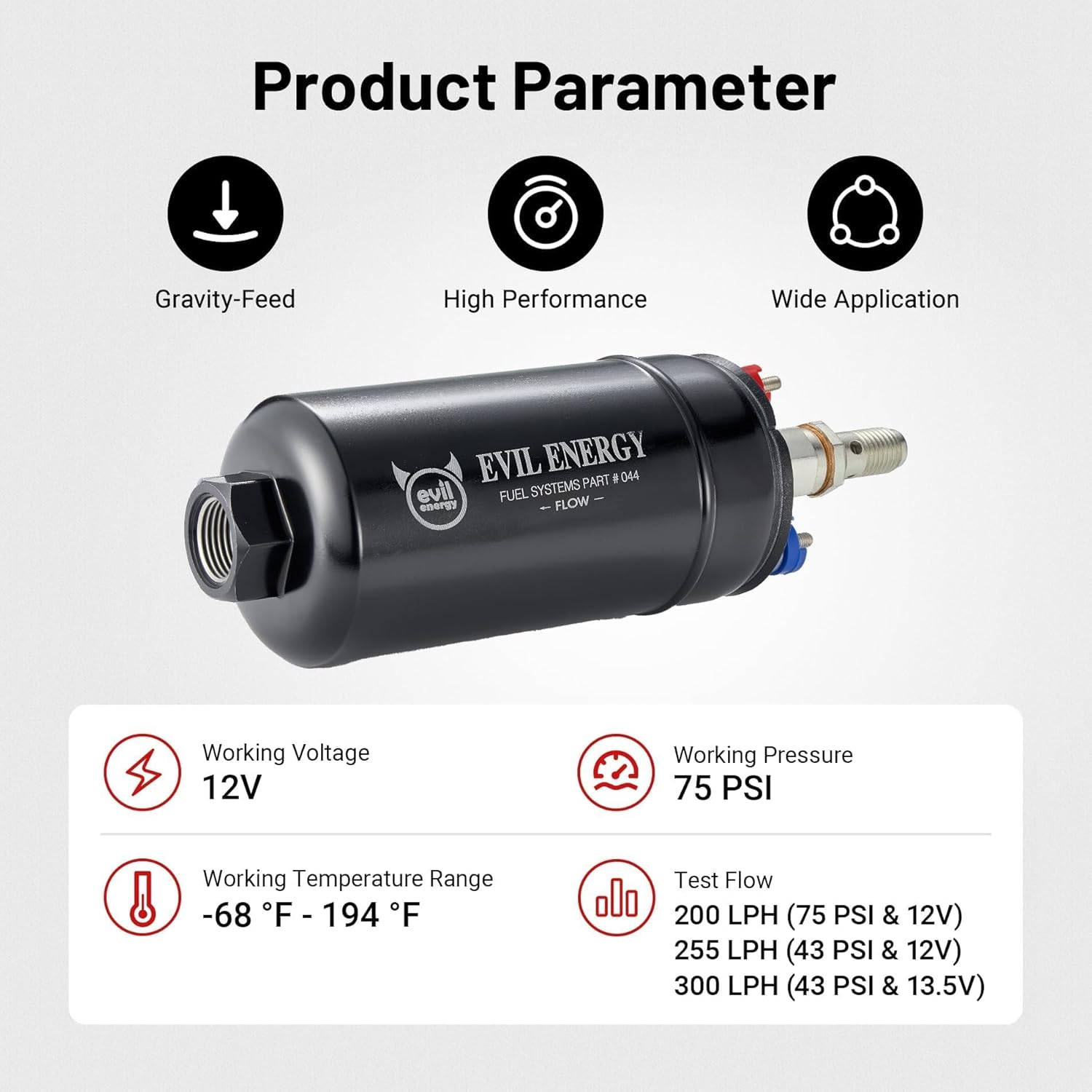
If you’ve been running a carburetor your whole life, the fuel pump question has always been simple: mechanical pump, maybe 6–7 psi, done. Swap in an EFI system, though, and the fuel pump becomes one of the most critical decisions in the whole build — and one of the easiest to get wrong. EFI (electronic fuel injection) needs higher fuel pressure, more consistent flow, and a pump specifically rated to keep up with your engine’s demand at wide-open throttle. Flow rate is measured in LPH — liters per hour — and it’s the number that tells you how much fuel a pump can move in a given window of time. Get it right and your engine runs clean at every rpm. Size down and you’ll run lean at peak power, which is where engines break. Size up without thinking it through and you’re spending money on pump capacity that does nothing useful. This guide will show you exactly how to match LPH to your horsepower goal, explain the variables that shift the math, and give you a clear decision framework before you order.
Why LPH Matters More Than You Think
The core tradeoff in fuel pump selection is deceptively simple: a fuel-injected engine at wide-open throttle pulls more fuel per minute than most people expect, and the pump you choose has to cover that peak demand with a safety margin to spare. Run too close to the limit and you risk a momentary lean condition — not enough fuel — exactly when cylinder pressure and heat are highest. That’s the scenario that melts pistons.
But the LPH number stamped on a pump box isn’t the whole story. Manufacturer-rated flow figures are typically measured at a relatively low pressure — often 13.5 volts and 40 psi — in a controlled setting. Real-world performance drops as line pressure rises. Aeromotive’s fuel system design documentation makes this explicit: a pump rated at 340 LPH at 40 psi may flow closer to 280 LPH at 58 psi, which is where a lot of return-style EFI systems actually run. Engine Labs has published similar guidance, noting that builders who skip the pressure-corrected flow table routinely undersize their pump by 15–25%.
The practical lesson: always look at the pump’s flow curve across multiple pressure points, not just the headline number. Most reputable pump manufacturers — Aeromotive, Walbro, DeatschWerks, Holley — publish these curves. If a product page only shows one number, ask for the data sheet.
The Horsepower-to-LPH Formula (And Where It Breaks Down)
The most widely cited starting point is a rule of thumb published repeatedly across enthusiast sources including Hot Rod Network and OnAllCylinders: 0.5 lbs of fuel per horsepower per hour for a naturally aspirated gasoline engine running at roughly a 12.5:1 air/fuel ratio. From there, you convert to LPH and add a safety margin.
Here’s the math stripped down:
By the numbers:
- 1 lb/hr of gasoline ≈ 0.63 LPH (gasoline density at ~6.3 lbs/gallon)
- Target: HP × 0.5 lbs/hr fuel ÷ BSFC correction × 0.63 = baseline LPH
- Add 20–25% safety margin on top of that baseline
- Example: 500 HP NA engine → ~158 LPH baseline → ~190–200 LPH minimum pump rating (at your actual system pressure)
That 500 HP example is why so many EFI builders running a Holley Sniper 2 or comparable self-learning TBI system on a mild big-block find that a 255 LPH pump sits comfortably in their window. Holley’s own Sniper EFI installation documentation recommends a high-pressure in-tank or inline pump flowing at least 255 LPH at system pressure for engines up to roughly 600 naturally aspirated horsepower — which aligns with the formula above.
Where the formula breaks down is when you leave the naturally aspirated, pump-gas baseline. Four variables push your LPH requirement up fast:
-
Boost (forced induction): Turbocharged and supercharged engines consume fuel at a higher rate relative to horsepower because the BSFC (brake-specific fuel consumption — the pounds of fuel an engine burns per horsepower per hour) climbs under boost. A conservative multiplier for a street supercharger application is 0.55–0.65 lbs/HP/hr instead of 0.50. A 500 HP supercharged engine may need a pump that flows 250+ LPH at elevated system pressure (60–65 psi).
-
E85 fuel: Ethanol blends require significantly more fuel volume to make the same power because E85 has a lower energy density than gasoline. The general multiplier is roughly 1.35–1.40× more fuel by volume. That 200 LPH gasoline pump becomes a 270–280 LPH minimum for E85. Engine Labs has documented this correction consistently in their EFI fuel system coverage.
-
Return vs. returnless systems: A return-style fuel system (where excess fuel circulates back to the tank) is more pump-friendly because the pump runs against a pressure regulator, not a dead-end. Returnless (demand-based) systems are common on factory LS setups and some modern EFI kits; they often run higher steady-state pressure and give the pump less thermal relief. If you’re adapting a returnless architecture, bump your flow target up.
-
Dual-pump setups and staged delivery: High-horsepower builds above 900 HP on gasoline, or 700 HP on E85, typically require either a single high-flow unit (Aeromotive Eliminator series, rated at 800+ LPH) or a dual-pump hat with staged activation. This is where the math forces a system-level conversation rather than a simple pump swap.
Matching Common EFI Kits to Pump Requirements
The EFI kit you’re pairing with the pump shapes your pressure requirement, which in turn affects which flow number to trust. Here’s how the most common enthusiast EFI systems sort out:
Entry-level throttle-body injection (FiTech Go Street, Holley Sniper 1): These systems typically run 58–62 psi. FiTech’s published installation documentation calls for a minimum 255 LPH pump. Builders running a mild 350–383 small-block in the 300–400 HP range will find that spec adequate, but there’s limited headroom. OnAllCylinders has noted in their EFI basics coverage that entry-level TBI kits are the most frequently undersupplied from a fuel delivery standpoint, especially when owners upgrade the engine without revisiting the fuel system.
Self-learning mid-range systems (Holley Sniper 2, MSD Atomic AirForce): Both run at similar pressure ranges (58–62 psi) and target applications up to 650 HP naturally aspirated. The Holley Sniper 2 installation manual specifies a 255 LPH minimum; MSD’s documentation for the Atomic AirForce calls for a minimum 340 LPH pump, which gives more meaningful headroom for the application’s power ceiling.
Performance standalone ECU with port injection (Holley HP EFI, Holley Dominator): At this level, fuel pressure is tunable (often 43–65 psi depending on injector sizing and base calibration), and the correct pump depends on final injector flow rate and target power. Holley’s technical support documentation and the Engine Labs coverage of HP EFI installs both consistently recommend a 340–450 LPH pump for street/strip builds up to 800 HP on gasoline.
Inline vs. in-tank: This is a legitimate decision point. In-tank pumps stay cooler because fuel acts as a coolant; inline pumps are easier to service on a resto-mod where dropping the tank isn’t trivial. Hot Rod Network’s EFI fuel system coverage has pointed out that inline pumps in a hot engine bay with marginal return flow can experience vapor lock on older fuel lines. Neither design is wrong; heat management is the variable.
The Decision Framework: If X, Then Y
Here’s how to walk through the decision before you spend money:
If you’re under 500 HP, naturally aspirated, on gasoline, with a Holley Sniper or comparable TBI kit: A 255 LPH in-tank or inline pump at rated system pressure covers you with margin. Don’t overspend here.
If you’re between 500–700 HP, naturally aspirated, on gasoline: Step up to a 340 LPH pump minimum, pressure-corrected to your system’s actual operating psi. Walbro 340, Aeromotive Stealth 340, and DeatschWerks DW300 all live in this tier and are regularly cited in aggregated builder reviews as reliable performers for this bracket.
If you’re adding a supercharger or turbo under 700 HP on gasoline: Use the 0.60 lbs/HP/hr BSFC correction. You’ll land in the 340–450 LPH range. Verify against your actual boost and target air/fuel ratio.
If you’re running E85 at any power level: Multiply your calculated LPH by 1.38 before applying your safety margin. A 500 HP E85 build needs approximately 275–290 LPH of pump capacity at system pressure — plan accordingly.
If you’re above 800 HP: You’re in Aeromotive Eliminator or dual-pump territory. This is a full fuel system design conversation, not a pump swap. Aeromotive’s fuel system design guide walks through the staging logic in detail and is worth reading directly.
If your system is returnless and you’re in a hot climate or track environment: Add 10–15% to your flow target and verify inlet line size (minimum 3/8-inch, ideally 1/2-inch) to avoid starving the pump. This is a commonly overlooked variable in LS swaps where the factory returnless architecture is retained.
One More Number to Keep Straight
Don’t confuse pump flow rate with injector flow rate. They’re related but separate decisions. Your pump has to supply enough fuel volume to keep injector rail pressure stable at full demand. Your injectors have to flow enough per cycle at your actual duty cycle and pressure. A 1,000 cc/min injector set flowing at 80% duty cycle can make about 600 HP on gasoline — but only if the pump can sustain the rail pressure those injectors need to hit that number consistently. If the pump drops pressure under load, the injector math falls apart regardless of injector size. The pump is the foundation; everything downstream depends on it.
Getting this right before you button up the engine bay saves you a diagnostic session on the dyno trying to chase a lean stumble that turns out to be a fuel delivery problem. Size the pump honestly, verify the pressure curve at your actual system pressure, and leave yourself a real margin — not a theoretical one.